
Short answer
Phong Nha is the gateway to Phong Nha–Ke Bang National Park, about 50 km northwest of Dong Hoi in Quang Tri province.[7][8] Its limestone karst has evolved over about 400 million years, the oldest major karst area in Asia, and has been a UNESCO World Heritage site since 2003.[1][2] It holds more than 300 caves, from Phong Nha Cave, which you enter by boat, to Son Doong, the largest cave in the world.[6][7]
Phong Nha–Ke Bang at a glance
2003
UNESCO World Heritage site, extended in 2015
~400 million
years of karst history
300+
caves
9
primate species
UNESCO first listed the park in 2003 for its geology. In 2015 the listing was extended to recognise its forests and wildlife, and in 2025 it became a joint World Heritage site with Hin Nam No National Park across the border in Laos.[1][2] Since 1 July 2025 the park has been in Quang Tri province, after Quang Binh and Quang Tri were merged into one province.[8]
The caves you can visit
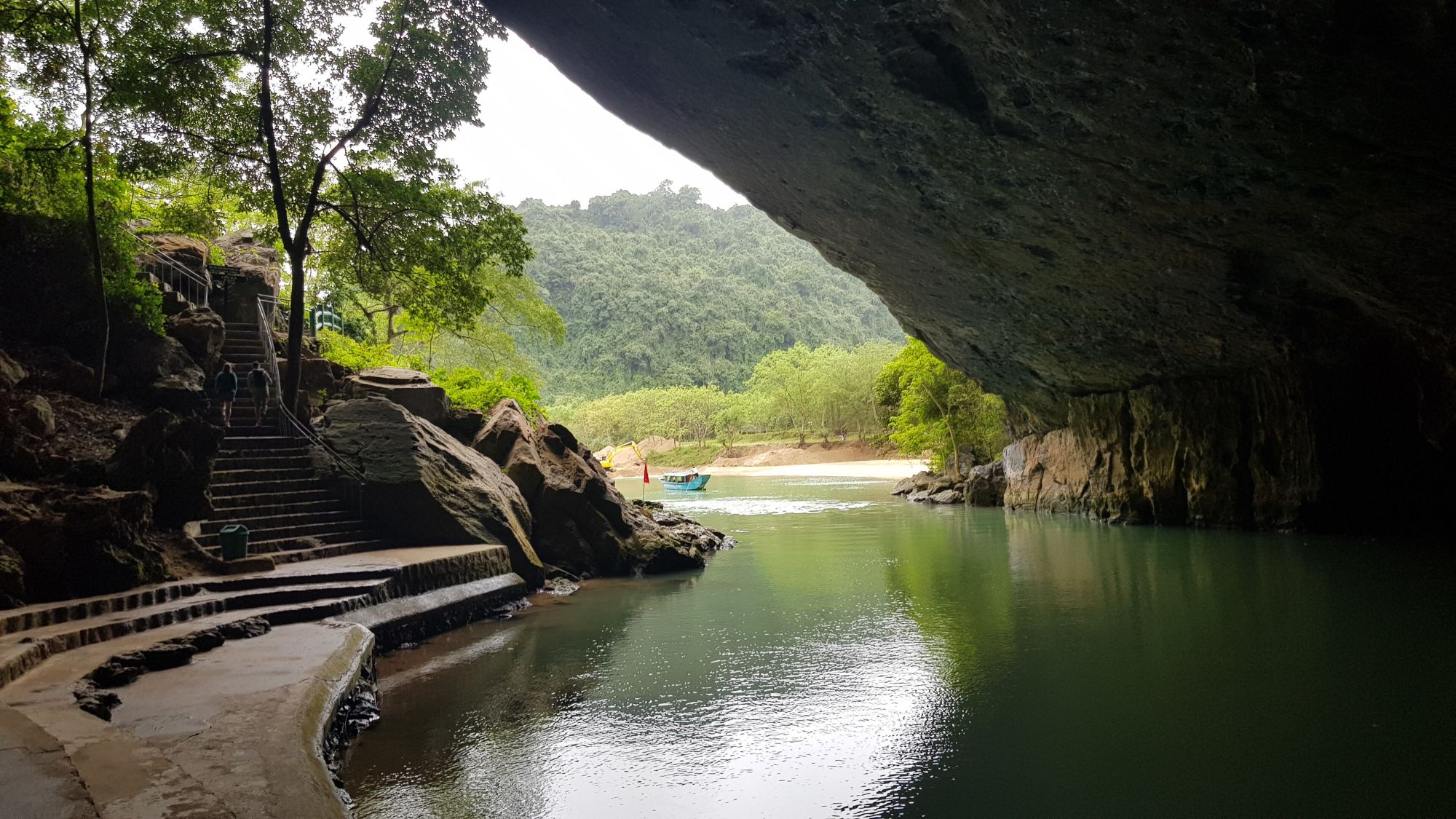
Phong Nha Cave: by boat
The park’s namesake is 7,729 m long. Boats run about 30 minutes along the Son river to the cave mouth; inside, the engine is cut and the boat is rowed about 1,200 m along the underground river. A visit takes about 2.5 hours. Entry is 150,000 VND per person (free under 1.3 m) and the boat is 700,000 VND round trip for up to 12 people. Open daily: 7:15 am to 4:30 pm in summer, 7:30 am to 3:45 pm in winter.[3]
Tien Son Cave
A dry cave above Phong Nha Cave, reached by nearly 600 stone steps. Visitors can go 400 m in. Entry 80,000 VND; a combined Phong Nha and Tien Son boat costs 750,000 VND.[3][12]
Paradise Cave (Thien Duong)
Found in 2005 by British cave explorers, it is 31.4 km long and up to 150 m wide, and the park calls it the longest dry cave in Asia. Visitors walk or take an electric buggy along a 1.6 km forest path, then explore about 1 km of wooden walkway inside. Entry 270,000 VND per adult, including the buggy. Longer guided treks deeper into the cave are also offered.[4]
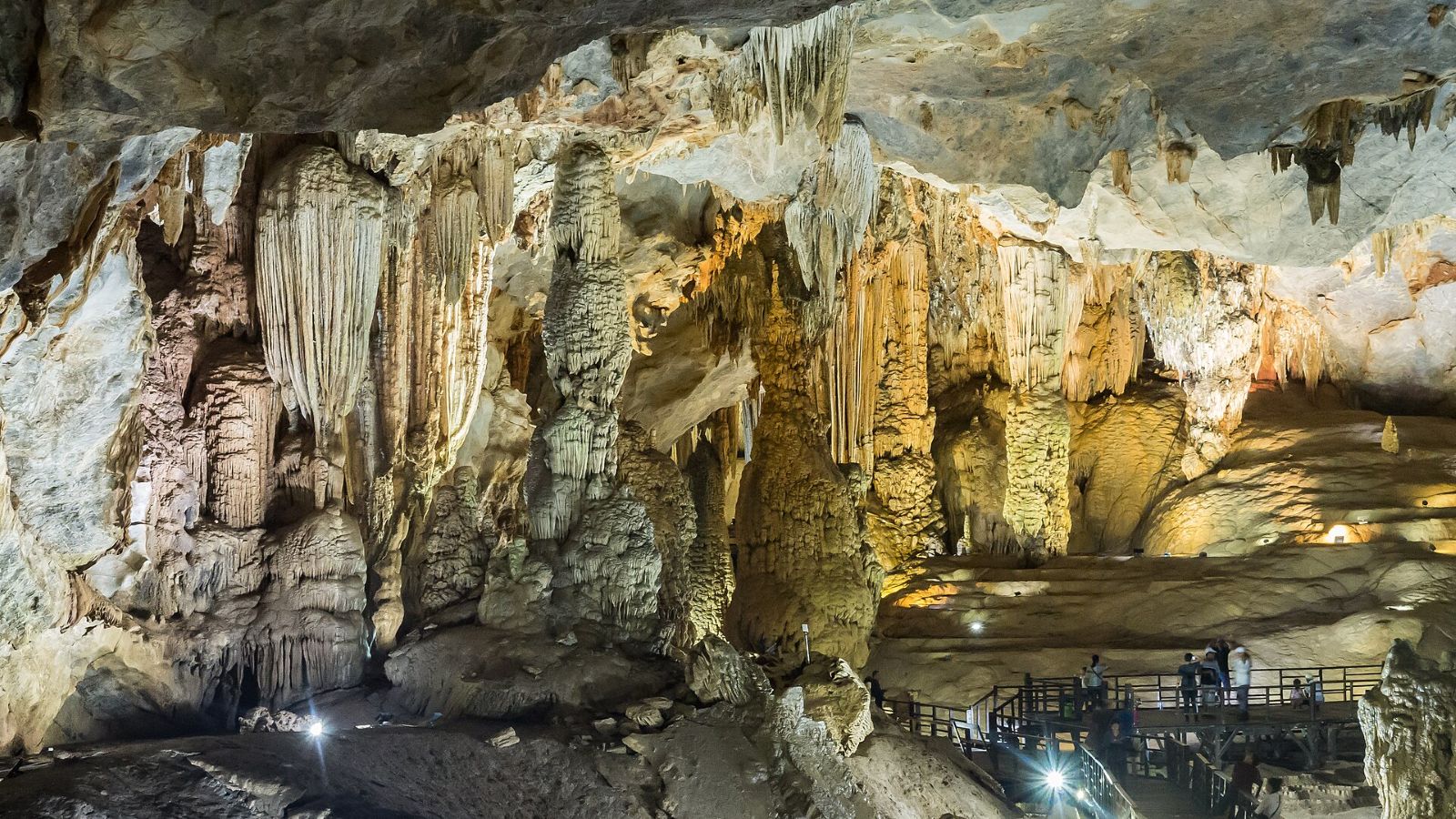
Inside Paradise Cave, on the wooden walkway.
Photo: Edgardo W. Olivera, CC BY 2.0, via Wikimedia Commons, resized.
Dark Cave (Hang Toi) on the Chay river
The active one: a 400 m zipline across the Chay river to the cave entrance, then caving, kayaking and a natural mud bath deep inside, which the park says is the only cave mud bath in Vietnam. The full package is 450,000 VND per adult and takes about 4 hours. Zipline riders must weigh over 40 kg, and the site can close in heavy rain or floods.[5]
Son Doong: the world’s largest cave
Found by a local man, Ho Khanh, in 1990, and surveyed by a British–Vietnamese caving expedition in 2009, Son Doong has a volume of about 38.5 million m³. You can only visit on a licensed expedition, run exclusively by Oxalis Adventure since 2013: 6 days and 5 nights, groups of up to 10, about 1,000 visitors a year, from January to August.[6]
Forest and wildlife
Beyond the caves, the park’s forests hold more than 2,700 plant species and more than 800 vertebrate species, including nine primates such as the endangered Hatinh langur and the red-shanked douc.[2]
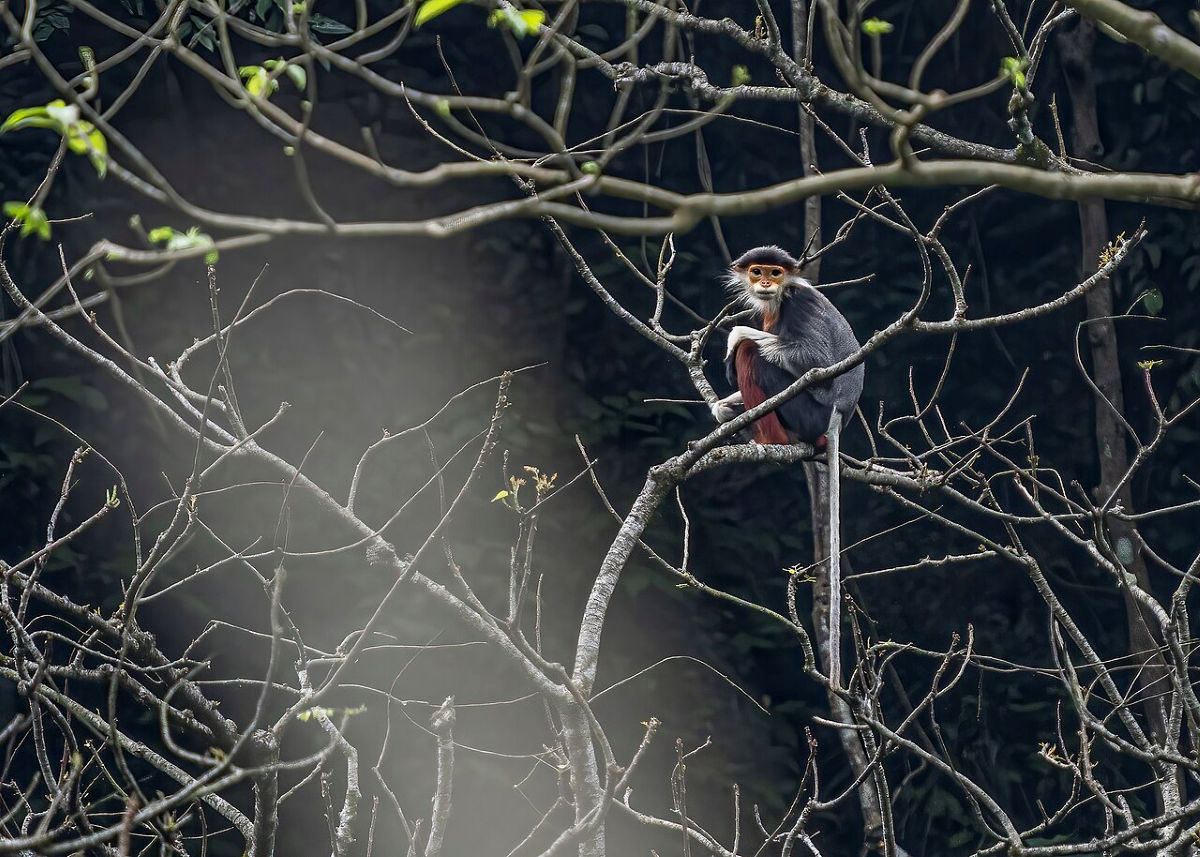
A red-shanked douc in Phong Nha–Ke Bang.
Photo: James Hunt, CC BY-SA 4.0, via Wikimedia Commons, resized.
War history: Road 20 and Tam Co Cave
Phong Nha sat on the Ho Chi Minh Trail. Road 20 Quyet Thang, a 125 km branch of the trail, starts at Km 0 in Phong Nha village and runs west to the Lao border. It was built in 1966, mostly by volunteers around 20 years old, and bombed heavily until 1972.[9]
On 14 November 1972, US bombs sealed the entrance of a cave beside the road, trapping and killing 13 people: eight youth volunteers, four women and four men, and five soldiers. The site, Hang Tam Co (“the cave of the eight young women”, named for the volunteers), is a special national monument.[9] It was restored and reopened on 14 November 2025.[10]
When to go
Riding with DME
Our flagship Truong Son War Trail rides into Phong Nha on Day 7, through the Truong Son mountains from Khe Sanh, then takes Day 8 off the bike for the caves: the boat trip into Phong Nha Cave, Paradise Cave and the Dark Cave. Before you go, read about Khe Sanh and the DMZ and the history of the Ho Chi Minh Trail. Questions? Ask us on WhatsApp.
Top photo: the river entrance of Phong Nha Cave, by Andre Hospers, CC BY 4.0, via Wikimedia Commons, resized.
Sources
- [1]UNESCO World Heritage Centre. Phong Nha-Ke Bang National Park and Hin Nam No National Park. whc.unesco.org
- [2]IUCN World Heritage Outlook. Phong Nha-Ke Bang National Park. worldheritageoutlook.iucn.org
- [3]Phong Nha–Ke Bang National Park. Phong Nha Cave. phongnhakebang.vn
- [4]Phong Nha–Ke Bang National Park. Động Thiên Đường (Paradise Cave). phongnhakebang.vn
- [5]Phong Nha–Ke Bang National Park. Tuyến du lịch Sông Chày – Hang Tối (Chay River – Dark Cave route). phongnhakebang.vn
- [6]Phong Nha–Ke Bang National Park. Chinh phục Sơn Đoòng – hang động lớn nhất thế giới (Son Doong, the world’s largest cave). phongnhakebang.vn
- [7]Department of Cultural Heritage, Ministry of Culture, Sports and Tourism. Vườn quốc gia Phong Nha - Kẻ Bàng (Phong Nha - Ke Bang National Park). dsvh.gov.vn
- [8]Báo Chính phủ (Government of Vietnam news portal). Nghị quyết của Quốc hội về sắp xếp đơn vị hành chính cấp tỉnh (National Assembly resolution on merging provinces). 12 June 2025. baochinhphu.vn
- [9]Phong Nha–Ke Bang National Park. Bài thuyết minh tại Di tích quốc gia đặc biệt Hang Tám Cô (Guide text for the Tam Co Cave special national monument). phongnhakebang.vn
- [10]Báo Chính phủ (Government of Vietnam news portal). Quảng Trị khánh thành công trình tôn tạo Di tích quốc gia đặc biệt Hang Tám Cô (Quang Tri opens the restored Tam Co Cave monument). 14 November 2025. baochinhphu.vn
- [11]Vietnam National Authority of Tourism. Phong Nha | Vietnam Tourism. vietnam.travel
- [12]Phong Nha–Ke Bang National Park. Động Tiên Sơn – Chốn bồng lai tiên cảnh (Tien Son Cave). phongnhakebang.vn
Based on UNESCO, IUCN, the national park’s official website and Vietnamese government sources. Ticket prices and opening hours are the park’s published figures and can change; check before you visit.
Last updated